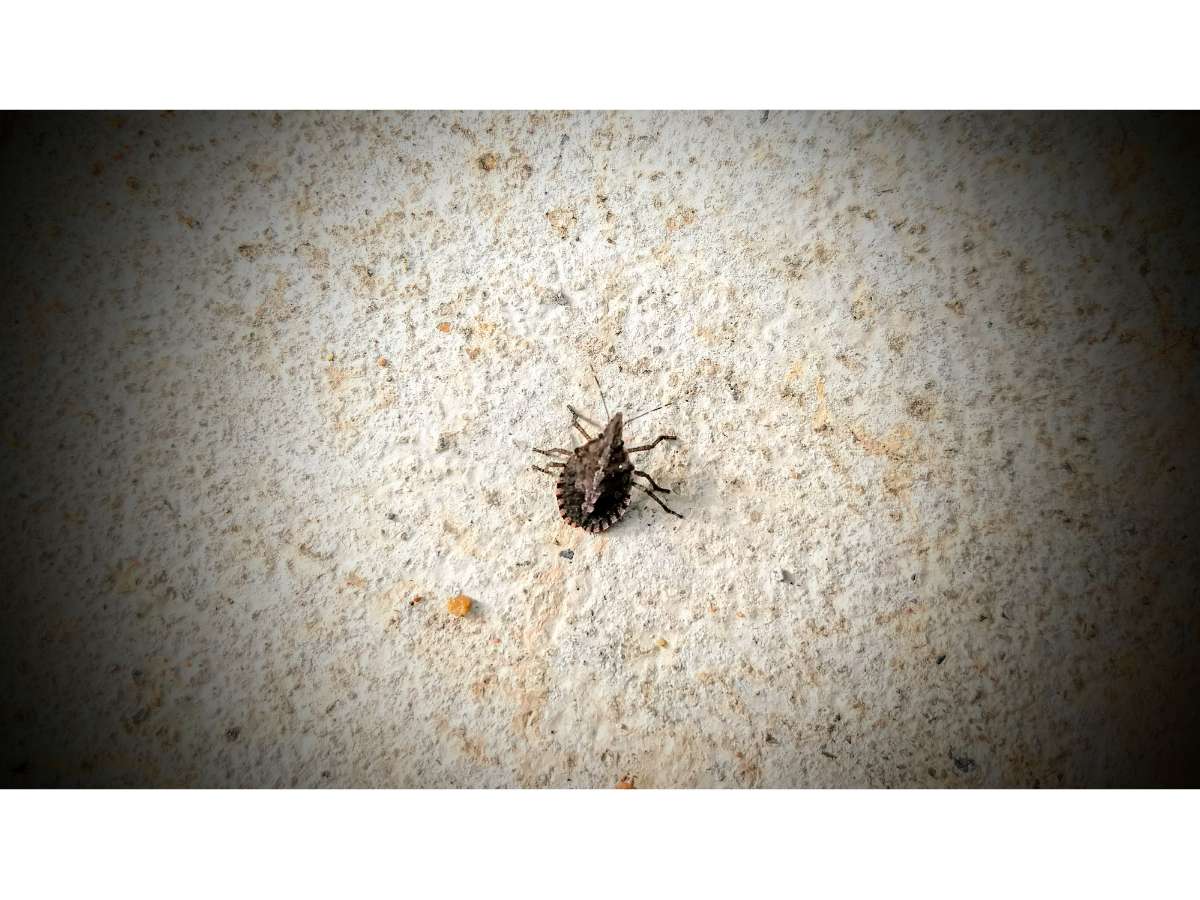
Brown Marmorated Stink Bug
Halyomorpha halys
🚨 Pest
⚠️ Medium Risk to Crops
🌍 Invasive
Common Names: Brown Marmorated Stink Bug, BMSB
Local Name: பழுப்பு நிற வாசனை வண்டு
Family: Pentatomidae
Order: Hemiptera
Size: 12–16 mm
Activity: Diurnal; gregarious
🔍 Identification
| Appearance | Shield-shaped body with mottled brown coloration; marbled pattern on wing covers; banded antennae and legs |
| Colour | Mottled brown with lighter and darker patches; underside lighter |
| Distinguishing Features | Alternating light/dark banding on antennae; smooth shoulder edges; emits strong unpleasant odour when disturbed |
| Eggs | Barrel-shaped, pale green; laid in clusters of 20–30 on leaf undersides |
🌿 Habitat & Behaviour
| Habitat | Orchards, gardens, agricultural fields, forests; highly adaptable; prefers fruit trees and vegetable crops |
| Behaviour | Gregarious; aggregates on host plants; strong fliers; migrate seasonally; overwinter in protected structures |
| Diet | Phytophagous — pierces fruit, leaves, and stems with stylet to feed on plant sap; wide host range including apples, pears, peaches, citrus, berries |
| Seasonal Presence | Spring to autumn; overwinters as adults; 2–3 generations per year |
🔄 Lifecycle
| Egg Stage | Clusters of 20–30 barrel-shaped eggs on leaf undersides; hatch in 4–5 days |
| Nymph Stage | 5 instars over 4–6 weeks; nymphs are brightly coloured and become more brown with age |
| Adult Stage | Adults overwinter; live several months; 2–3 generations per year in warm climates |
| Overwintering | Adults seek sheltered locations (under bark, in buildings) to overwinter |
🌾 Orchard Impact
| Impact Type | Pest — significant crop damage |
| Crops Affected | Apples, pears, peaches, citrus, berries, figs, grapes, vegetables |
| Damage Description | Piercing feeding causes dimpling, discolouration, and corky tissue under fruit skin; makes fruit unmarketable |
| Damage Severity | High — can cause 30–90% crop loss in severe infestations |
🛡️ Pest Status & Safety
| Pest Classification | Major agricultural pest; invasive species in many regions |
| Danger to Humans | Low — not venomous; unpleasant odour when crushed; may cause mild skin irritation |
| Invasive Status | Invasive — native to East Asia; introduced to North America, Europe, and other regions |
🚫 Prevention & Control
| Physical Control | Exclusion netting over fruit trees; hand-picking and dropping in soapy water; sticky traps |
| Pheromone Traps | Aggregation pheromone traps for monitoring and mass trapping |
| Biological Control | Parasitoid wasps (Trissolcus japonicus); encourage natural predators (birds, spiders) |
| Organic Sprays | Neem oil; insecticidal soap; kaolin clay on fruit surfaces |
| Early Warning Signs | Dimpled or discoloured fruit; unpleasant odour; aggregations on sunny sides of trees in autumn |
📝 Orchard Observation Notes
Add your field observations here.