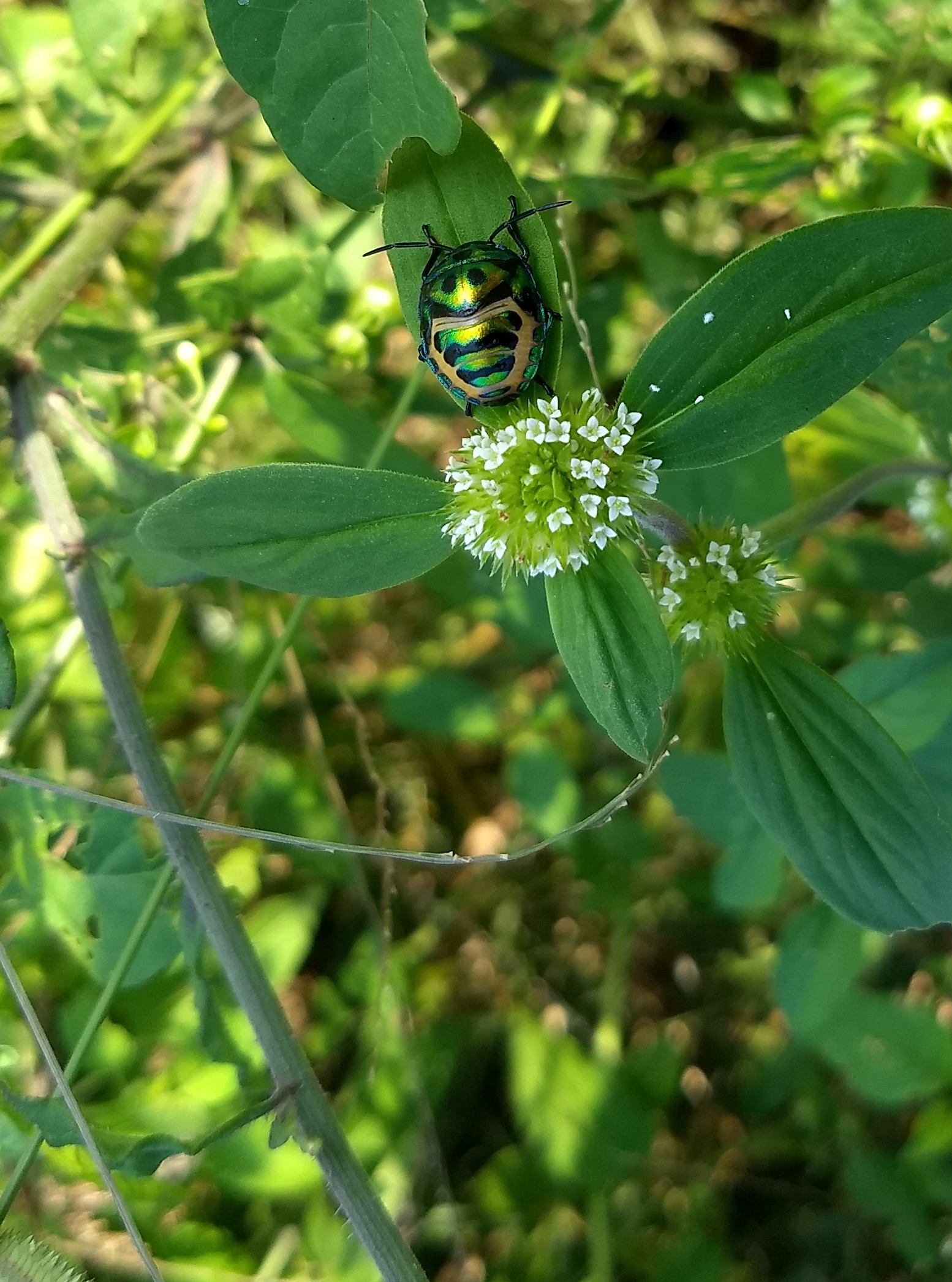
Lychee Shield Bug
Chrysocoris stollii
🚨 Pest
Common Names: Lychee Shield Bug, Jewel Bug, Metallic Shield Bug
Local Name: நகைப் பூச்சி (Nagaip Pūchchi)
Family: Scutelleridae
Order: Hemiptera
Size: 18–25 mm
Activity: Diurnal
🔍 Identification
| Appearance | Broad, shield-shaped bug with a greatly enlarged scutellum covering the entire abdomen and wings. Brilliant metallic coloration gives it a jewel-like appearance. |
| Colour | Metallic blue, green, or purple dorsum; yellow abdominal underside broadly margined with purple; black spots around spiracles |
| Distinguishing Features | Enlarged scutellum forming a continuous shield over abdomen; iridescent metallic sheen; often mistaken for a beetle |
| Similar Species | Other Chrysocoris species and Calliphara nobilis; distinguished by specific colour pattern and abdominal markings |
🌿 Habitat & Behaviour
| Habitat | Orchards, gardens, agricultural fields, and forest edges across continental Southeast Asia and the Indian subcontinent |
| Behaviour | Feeds on plant sap using piercing-sucking mouthparts; often found in aggregations on host plants; releases foul odour when disturbed |
| Activity Pattern | Active during daytime; often seen basking on leaves in sunlight |
| Diet | Polyphagous sap-feeder — pigeon pea, pongamia, jatropha, arecanut, coffee senna, and various other plants |
| Seasonal Presence | Year-round in tropical regions; most abundant during warm, humid months |
| Host Plants | Pigeon pea (Cajanus cajan), Pongamia, Jatropha, Arecanut, Coffee Senna, Lychee |
🔄 Lifecycle
| Egg Stage | Eggs laid in clusters on the underside of host plant leaves; barrel-shaped and pale green |
| Nymph Stage | 5 nymphal instars; nymphs are less colourful than adults, gradually developing metallic sheen with each moult |
| Adult Stage | Adults are long-lived; feed and reproduce on host plants throughout the warm season |
| Generations per Year | Multiple generations per year in tropical climates |
🌾 Orchard Impact
| Impact Type | Pest — sap-feeding causes plant stress and yield loss |
| Crops Affected | Pigeon pea, pongamia, jatropha, arecanut, coffee senna, lychee, and various ornamental plants |
| Damage Description | Sap-sucking weakens plants, causes wilting and reduced vigour; heavy infestations lead to flower and fruit drop |
| Damage Severity | Moderate; can be significant in pigeon pea and arecanut plantations |
🛡️ Pest Status & Safety
| Pest Classification | Polyphagous pest of multiple crops; most damaging to pigeon pea and arecanut |
| Danger to Humans | None — harmless to humans; may release a foul-smelling defensive secretion when handled |
| Invasive Status | Native to continental Southeast Asia and the Indian subcontinent; not invasive |
🚫 Prevention & Control
| Physical Control | Hand-pick adults and nymphs from plants; destroy egg clusters on leaf undersides |
| Biological Control | Encourage egg parasitoids and predatory insects; maintain habitat for natural enemies |
| Organic Sprays | Neem oil spray to deter feeding; insecticidal soap for nymph control |
| Early Warning Signs | Aggregations of brightly coloured bugs on plant stems and leaves; wilting or yellowing of infested shoots |
📝 Orchard Observation Notes
Add your field observations here.