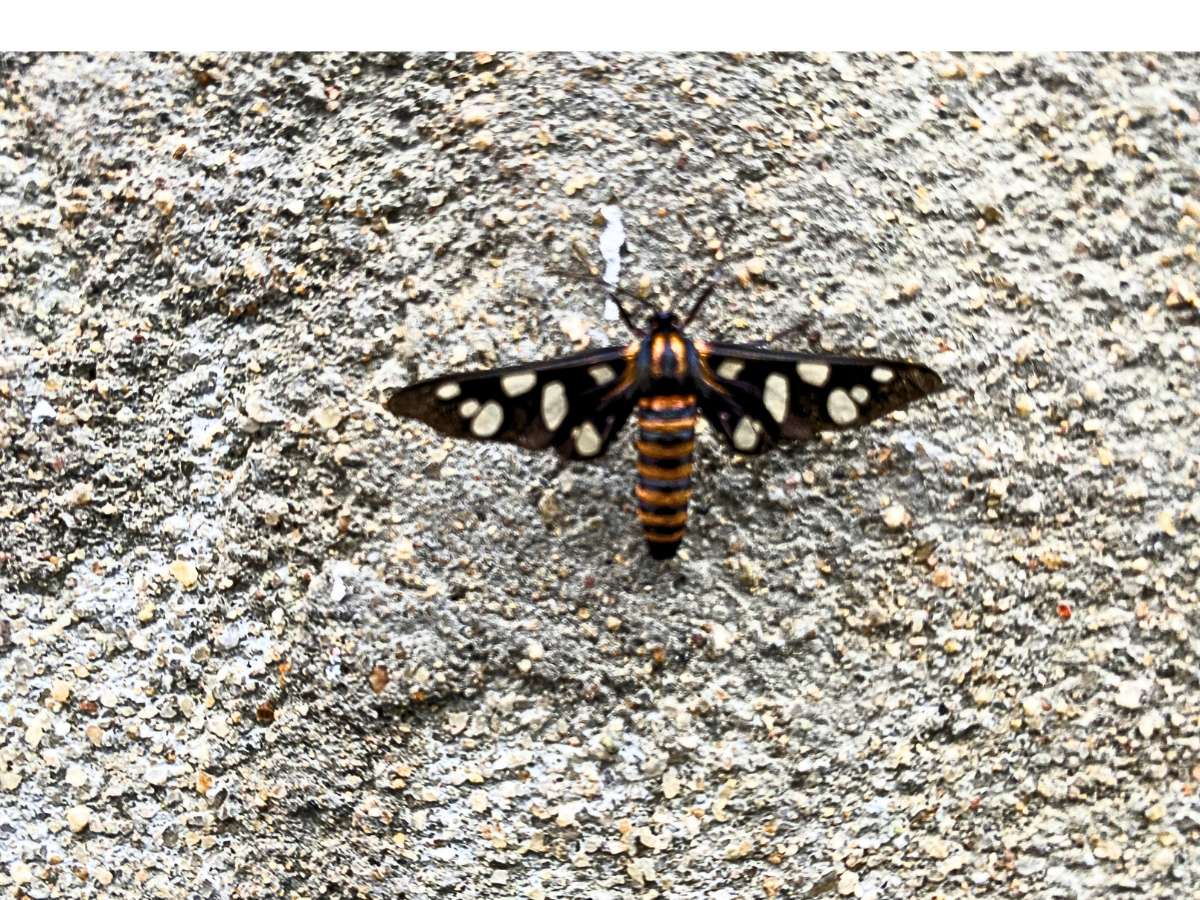
Sandalwood Defoliator Moth
Amata passalis
🚨 Pest
Common Names: Sandalwood Defoliator, Handmaiden Moth, Indian Wasp Moth
Local Name: சந்தன இலையுதிர் அந்துப்பூச்சி (Sandana Ilaiyudir Andhuppūchchi)
Family: Erebidae
Order: Lepidoptera
Size: 30–40 mm wingspan
Activity: Diurnal (day-flying)
🔍 Identification
| Appearance | Slender, wasp-like moth with narrow dark wings marked by translucent white or yellowish spots. Abdomen banded with bright orange-yellow and black rings. |
| Colour | Black wings with white or pale yellow translucent patches; abdomen black with orange-yellow bands |
| Distinguishing Features | Wasp-mimicking appearance with narrow wings, bright abdominal banding, and slow buzzing flight during daytime |
| Similar Species | Amata cyssea (Handmaiden Moth) — distinguished by wing spot pattern and abdominal band count |
🌿 Habitat & Behaviour
| Habitat | Orchards, gardens, sandalwood plantations, pulse crop fields, and ornamental gardens across India and Sri Lanka |
| Behaviour | Day-flying moth with slow, buzzing flight; mimics wasps to deter predators; larvae are gregarious feeders |
| Activity Pattern | Active during daylight hours; adults emerge within 1–2 hours of sunrise |
| Diet | Larvae feed on sandalwood leaves, cowpeas, pulses, and ornamental plants; adults feed on nectar |
| Seasonal Presence | Year-round breeding in tropical climates; 6–11 generations per year |
| Host Plants | Sandalwood (Santalum album), cowpea (Vigna unguiculata), French bean (Phaseolus vulgaris), snake gourd, capsicum |
🔄 Lifecycle
| Egg Stage | Female lays about 305 eggs in clusters on host plant leaves over a lifespan of ~4 days |
| Larval Stage | Eight larval instars; first instar ~2 mm, final instar ~29 mm; hairy caterpillars that feed gregariously |
| Pupal Stage | Pupation occurs in a loose cocoon among leaf litter or soil |
| Adult Stage | Adults emerge at sunrise; mating occurs within a day of emergence; average life cycle ~62 days |
| Generations per Year | 6–11 generations per year; breeds year-round in tropical regions |
🌾 Orchard Impact
| Impact Type | Pest — larvae cause severe defoliation |
| Crops Affected | Sandalwood, cowpeas, French beans, snake gourd, capsicum, and ornamental plants |
| Damage Description | Gregarious larvae skeletonize and defoliate leaves, reducing photosynthesis and weakening the plant; severe infestations can strip entire branches |
| Damage Severity | High in sandalwood plantations; moderate in pulse crops |
🛡️ Pest Status & Safety
| Pest Classification | Major pest of sandalwood; minor pest of pulses and vegetables |
| Danger to Humans | None — harmless to humans; larvae may cause mild skin irritation due to body hairs |
| Invasive Status | Native to India and Sri Lanka; not considered invasive |
🚫 Prevention & Control
| Physical Control | Hand-pick and destroy egg clusters and gregarious larvae from infested leaves |
| Biological Control | Parasitoid wasp Apanteles nepitae is effective against larvae; encourage natural predators |
| Organic Sprays | Neem oil spray on young larvae; Bacillus thuringiensis (Bt) spray for caterpillar control |
| Early Warning Signs | Skeletonized leaves, presence of hairy caterpillars feeding in groups, day-flying wasp-like moths near host plants |
📝 Orchard Observation Notes
Add your field observations here.