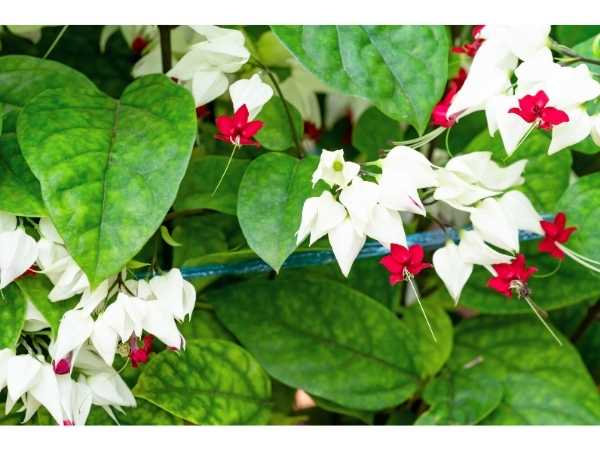
Bleeding Heart
Lamprocapnos spectabilis
Common Names: Bleeding Heart, Old-fashioned Bleeding Heart, Venus's Car, Lyre Flower
Local Name: Bleeding Heart (English)
Family: Papaveraceae
Origin: East Asia (China, Korea, Japan)
Plant Type: Herbaceous perennial
Variety: Pink (classic), Alba (white), Gold Heart (golden foliage), Valentine (red)
Average Lifespan: 3–5 years (individual clumps); indefinite with division
🌿 Botanical Description
| Growth Habit | Clump-forming herbaceous perennial with arching stems; goes dormant in summer heat |
| Plant Size | 60–90 cm tall, 45–75 cm spread |
| Leaves | Compound, deeply dissected, fern-like, blue-green to grey-green, 30–40 cm long |
| Flowers | Heart-shaped, pendant, 2–3 cm long, borne in arching racemes of 3–15 flowers |
| Flower Characteristics | Outer petals pink or white forming the heart shape; inner petals white, protruding like a drop; zygomorphic symmetry |
| Fruit | Elongated capsule, 3–4 cm long, splitting open when ripe to release seeds |
| Fruit Color | Green maturing to brown |
| Seed Characteristics | Small, round, black, shiny seeds with elaiosomes (ant-dispersed); require cold stratification for germination |
| Root System | Fleshy, brittle rhizomatous root system; spreads slowly to form clumps |
☀ Growing Conditions
| Climate | Temperate; thrives in cool, moist conditions; USDA zones 3–9 |
| Temperature Range | 10–24°C ideal; tolerates winter cold to −40°C when dormant; goes dormant above 30°C |
| Rainfall Requirement | 600–1200 mm annually; consistent moisture preferred |
| Soil Type | Humus-rich, well-drained, moist loamy soil with high organic matter |
| Soil pH Preference | 6.0–7.0 (slightly acidic to neutral) |
| Sun Requirement | Partial shade to full shade; morning sun with afternoon shade ideal |
| Spacing | 45–60 cm between plants |
| Irrigation Method | Drip irrigation or gentle watering at soil level; avoid wetting foliage |
| Water Requirement | Moderate; keep soil consistently moist but never waterlogged |
| Can it Grow in Pots? | Yes, in large containers (15+ liters) with good drainage; bring indoors in extreme heat |
🌾 Cultivation & Care
| Fertilizer Schedule | Once in early spring as new growth emerges; light feeding monthly during active growth |
| Recommended Organic Fertilizers | Compost, leaf mold, well-rotted manure, balanced organic fertilizer (10-10-10) |
| Pesticide Frequency | Rarely needed; generally pest-free |
| Recommended Organic Pesticides | Neem oil for aphids; slug pellets or beer traps for slugs and snails |
| Mulching Practice | 5–8 cm organic mulch (leaf mold, bark chips) to retain moisture and keep roots cool |
| Training System | No training needed; naturally forms graceful arching mounds |
| Pruning Time | After foliage yellows and dies back naturally in summer; cut to ground level in autumn |
| How to Prune | Remove spent flower stems to encourage reblooming; cut back yellowed foliage to ground level |
| Common Pests | Aphids, slugs, snails; generally very pest-resistant |
| Common Diseases | Fusarium wilt, verticillium wilt, powdery mildew, stem rot in waterlogged conditions |
| Disease Prevention & Remedies | Ensure good drainage, avoid overhead watering, provide air circulation, remove infected foliage promptly |
🌸 Flowering & Fruiting
| Flowering Months | April–June (spring to early summer); may rebloom in cool autumns |
| Fruiting Season | Late spring to early summer; capsules mature 4–6 weeks after flowering |
| Days to Harvest | Cut flowers when 3–4 blooms are open on the raceme for best vase life |
| Harvest Indicators | Flowers fully colored and pendant; seed capsules turn brown when ripe |
| Average Yield per Plant | 10–20 flowering stems per mature clump per season |
| Pollination Type | Insect-pollinated; primarily by bumblebees |
| Pollination Notes | Long-tongued bumblebees are the primary pollinators; flower shape excludes most other insects |
🌱 Pollination & Propagation
| Pollination Details | Bumblebees pry open the heart-shaped petals to access nectar; seeds have elaiosomes for ant dispersal (myrmecochory) |
| Propagation by Seeds | Requires 4–6 weeks cold stratification at 4°C; sow in autumn outdoors or stratify in refrigerator; germination in 30–90 days |
| Propagation by Cuttings | Root cuttings in late autumn (5–8 cm sections); stem cuttings in spring after new growth emerges |
| Propagation by Grafting | Division of rhizomes in early spring or autumn is the most reliable method; divide every 3–4 years |
🌿 Cultural Significance
| Symbolism | Symbolizes unconditional love, compassion, and romantic devotion; in Asian folklore, associated with unrequited love and the story of a prince who won a maiden's heart |
| Traditional Uses | Cultivated in Chinese and Japanese gardens for centuries as an ornamental; featured in Victorian cottage gardens; popular in shade garden design worldwide |
🌿 Medicinal Uses
| Traditional Medicine | Used in traditional Chinese medicine for treating bruises, traumatic injuries, and menstrual irregularities |
| Active Compounds | Contains isoquinoline alkaloids including protopine, sanguinarine, and allocryptopine |
| Anti-inflammatory Properties | Alkaloid extracts show anti-inflammatory and analgesic activity in traditional preparations |
| Caution | All parts of the plant are toxic if ingested; can cause skin irritation on contact; keep away from children and pets |
Disclaimer: Information provided is for educational purposes only and not a substitute for medical advice.
📸 Photo Gallery
📝 Orchard Observation Notes
Add your field observations here.