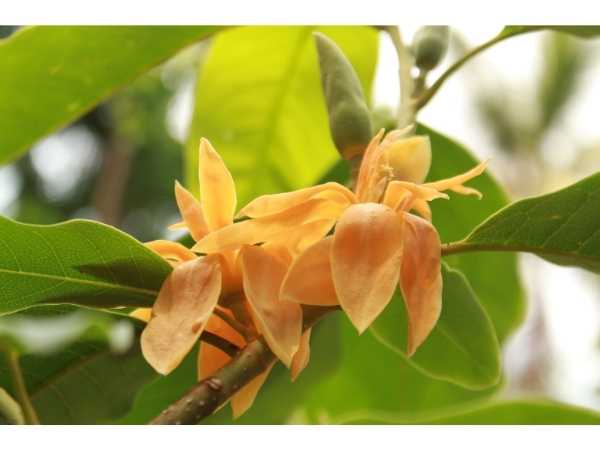
Champak
Magnolia champaca
Common Names: Champak, Champaca, Golden Champa, Joy Perfume Tree
Local Name: Shenbagam (Tamil), Champa (Hindi), Champakam (Malayalam)
Family: Magnoliaceae
Origin: South and Southeast Asia (India, Indonesia, Malaysia)
Plant Type: Large evergreen tree
Variety: Golden Champak (yellow-orange flowers), White Champak (Magnolia × alba, white flowers)
Average Lifespan: 100+ years; some specimens over 200 years old
🌿 Botanical Description
| Growth Habit | Large, upright evergreen tree with a narrow conical to columnar crown; straight trunk with smooth grey bark |
| Plant Size | 20–50 meters tall; trunk diameter up to 1.8 meters |
| Leaves | Alternate, simple, lanceolate to ovate, 15–30 cm long, glossy dark green above, paler beneath, with wavy margins |
| Flowers | Solitary, 5–7 cm diameter, 12–15 tepals, intensely fragrant golden-yellow to orange |
| Flower Characteristics | Powerfully sweet fragrance detectable from great distance; flowers open in morning, fragrance strongest at dawn; spiral arrangement of tepals typical of magnolias |
| Fruit | Aggregate fruit cluster, 7–15 cm long, composed of many follicles on a central spike; woody when mature |
| Fruit Color | Green maturing to brownish-grey; seeds bright red-orange with fleshy aril |
| Seed Characteristics | Seeds enclosed in bright red-orange fleshy aril; 1–2 seeds per follicle; dispersed by birds attracted to the colorful aril |
| Root System | Deep taproot with extensive lateral roots; fleshy, rope-like roots sensitive to damage |
☀ Growing Conditions
| Climate | Tropical to subtropical; warm and humid; frost-sensitive |
| Temperature Range | 20–35°C ideal; can tolerate brief periods down to 5°C; damaged by frost |
| Rainfall Requirement | 1500–3000 mm annually; thrives in monsoon climates |
| Soil Type | Deep, well-drained, fertile acidic soil rich in organic matter; loamy to clay-loam |
| Soil pH Preference | 5.5–7.0 (acidic to neutral) |
| Sun Requirement | Full sun to partial shade; young trees benefit from light shade |
| Spacing | 8–12 meters between trees (large tree; needs ample space) |
| Irrigation Method | Regular watering for young trees; basin irrigation; mature trees are moderately drought-tolerant |
| Water Requirement | Moderate to high; consistent moisture preferred, especially during flowering |
| Can it Grow in Pots? | Young trees only, in very large containers (50+ liters); must be transplanted to ground eventually |
🌾 Cultivation & Care
| Fertilizer Schedule | Twice yearly (pre-monsoon and post-monsoon); young trees monthly during growing season |
| Recommended Organic Fertilizers | Well-rotted cow dung, compost, neem cake, bone meal; acidifying fertilizers beneficial |
| Pesticide Frequency | Monitor seasonally; treat as needed during monsoon |
| Recommended Organic Pesticides | Neem oil for scale and mealybugs; Bacillus thuringiensis for caterpillars |
| Mulching Practice | Thick organic mulch (10–15 cm) of leaf litter around base; mimics forest floor conditions |
| Training System | Central leader training for straight trunk; minimal pruning needed for natural form |
| Pruning Time | After main flowering flush; avoid heavy pruning |
| How to Prune | Remove dead, diseased, or crossing branches; light shaping only; avoid cutting large limbs as wounds heal slowly |
| Common Pests | Scale insects, mealybugs, leaf miners, bark borers, flower thrips |
| Common Diseases | Leaf spot, sooty mold, root rot in waterlogged soil, algal leaf spot in humid conditions |
| Disease Prevention & Remedies | Good drainage, avoid root disturbance, copper fungicide for leaf spot, remove fallen debris |
🌸 Flowering & Fruiting
| Flowering Months | April–September (main flush); sporadic flowering year-round in tropical climates |
| Fruiting Season | August–December; fruits mature 4–6 months after flowering |
| Days to Harvest | Flowers picked at dawn when fragrance is strongest; just before full opening |
| Harvest Indicators | Buds plump and showing color; maximum fragrance at early morning; petals begin to loosen |
| Average Yield per Plant | 5–15 kg of flowers per mature tree per season; increases with age |
| Pollination Type | Beetle-pollinated (cantharophily); also visited by bees |
| Pollination Notes | Beetles are primary pollinators, attracted by strong fragrance; flowers are protogynous (female parts mature before male) to promote cross-pollination |
🌱 Pollination & Propagation
| Pollination Details | Protogynous flowers ensure cross-pollination; beetles enter flowers attracted by fragrance and warmth; ancient pollination syndrome shared with all magnolias |
| Propagation by Seeds | Remove fleshy red aril, sow fresh seeds immediately; germination in 15–30 days; seeds lose viability quickly if dried |
| Propagation by Cuttings | Semi-hardwood cuttings with rooting hormone; success rate moderate (40–60%); air layering more reliable |
| Propagation by Grafting | Approach grafting and veneer grafting onto seedling rootstock; produces flowering trees in 3–4 years vs 8–10 years from seed |
💧 Environmental Impact & Sustainability
| Water Usage | Moderate to high; large canopy provides significant evapotranspiration cooling |
| Soil Conservation Practices | Deep root system prevents soil erosion; leaf litter enriches soil; excellent shade tree |
| Organic Practices Used | Leaf mulch recycling, organic manuring, minimal chemical inputs needed |
| Companion Plants | Shade-tolerant understory plants: ferns, gingers, cardamom, pepper vines |
| Biodiversity Benefits | Supports beetles, bees, birds (fruit-eating); large canopy provides habitat for epiphytes and nesting birds; important in tropical forest ecosystems |
💰 Economic Importance
| Commercial Production Regions | India (Tamil Nadu, Karnataka, Kerala), Indonesia, Malaysia, Myanmar, Thailand |
| Market Uses | Flowers for perfumery, religious offerings, garlands; timber for furniture and construction |
| Processing Uses | Essential oil extraction (champaca absolute), attar production, incense, cosmetics; timber for plywood, furniture, and light construction |
| Market Value (Approx.) | ₹300–800 per kg of flowers; champaca absolute oil ₹50,000–100,000 per kg; timber ₹1500–3000 per cubic foot |
🌿 Cultural Significance
| Symbolism | Sacred tree in Hinduism (associated with Lord Vishnu and Goddess Lakshmi) and Buddhism (believed to be the tree under which the future Buddha Maitreya will attain enlightenment) |
| Traditional Uses | Flowers offered in Hindu and Buddhist temples daily; used in South Indian weddings and festivals; women wear champak flowers in hair; featured in classical Tamil Sangam literature and Sanskrit poetry |
🌿 Medicinal Uses
| Traditional Medicine | Used extensively in Ayurveda and traditional Southeast Asian medicine; bark, flowers, and leaves all have medicinal applications |
| Active Compounds | Contains linalool, methyl-2-methylbutyrate, indole, β-elemene; bark contains alkaloids micheline and liriodenine |
| Anti-inflammatory Properties | Bark extract used in Ayurveda for fever, rheumatism, and inflammation; shows anti-inflammatory activity in studies |
| Digestive Health | Bark decoction used traditionally for digestive disorders, nausea, and as a stomachic tonic |
| Immune Support | Flower and leaf extracts show antimicrobial and antioxidant properties; used in traditional fever remedies |
| Heart Health | Bark preparations used in traditional medicine as a cardiac tonic and for regulating blood pressure |
Disclaimer: Information provided is for educational purposes only and not a substitute for medical advice.
📸 Photo Gallery
📝 Orchard Observation Notes
Add your field observations here.