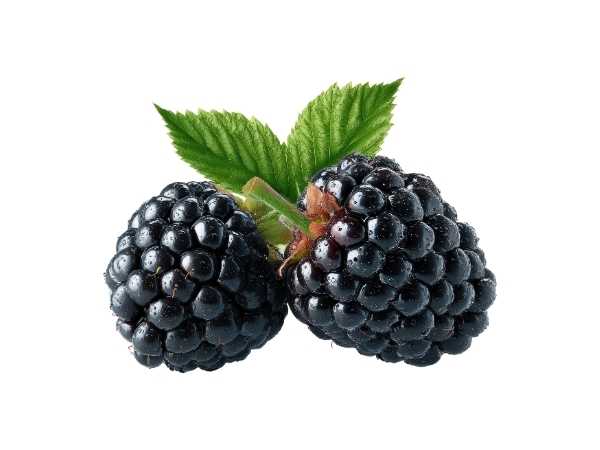
Blackberry
Rubus fruticosus
Common Names: Blackberry, Bramble, European Blackberry
Local Name: Jamun Ber (Hindi)
Family: Rosaceae
Origin: Europe, North America, temperate Asia
Plant Type: Perennial thorny shrub (bramble)
Variety: Erect, semi-erect, and trailing types; thornless cultivars available
Average Lifespan: 15–20 years (individual canes are biennial)
🌿 Botanical Description
| Growth Habit | Vigorous arching or trailing bramble with biennial canes |
| Plant Size | 1–3 meters tall; trailing types up to 5 meters long |
| Leaves | Palmately compound, 3–5 leaflets, serrated margins, dark green above |
| Flowers | White to pale pink, 2–3 cm diameter, 5 petals in clusters |
| Flower Characteristics | Borne on second-year canes (floricanes); mildly fragrant |
| Fruit | Aggregate drupe, 1.5–3 cm long; composed of many small drupelets |
| Fruit Color | Green to red to glossy black when fully ripe |
| Seed Characteristics | Small hard seed (pyrene) inside each drupelet |
| Root System | Perennial root crown with spreading lateral roots; suckers freely |
☀ Growing Conditions
| Climate | Temperate to subtropical; needs winter chill for fruiting |
| Temperature Range | 15–25°C ideal; requires 200–700 chill hours below 7°C |
| Rainfall Requirement | 750–1500 mm annually; consistent moisture during fruiting |
| Soil Type | Well-drained, fertile loam rich in organic matter |
| Soil pH Preference | 5.5–6.5 |
| Sun Requirement | Full sun (6–8 hours daily) |
| Spacing | 1–2 meters between plants; 2–3 meters between rows |
| Irrigation Method | Drip irrigation preferred; avoid wetting foliage |
| Water Requirement | Moderate to high during fruiting; 25–50 mm per week |
| Can it Grow in Pots? | Yes, compact varieties in 20–30 liter pots with trellis |
🌾 Cultivation & Care
| Fertilizer Schedule | Early spring and after first harvest; avoid late-season feeding |
| Recommended Organic Fertilizers | Compost, aged manure, blood meal, kelp meal |
| Pesticide Frequency | Monitor regularly; treat as needed |
| Recommended Organic Pesticides | Neem oil, pyrethrin, insecticidal soap, Bt for caterpillars |
| Mulching Practice | Thick organic mulch (straw, wood chips) to retain moisture and suppress weeds |
| Training System | T-trellis or V-trellis; separate primocanes from floricanes |
| Pruning Time | After harvest — remove spent floricanes; tip-prune primocanes in summer |
| How to Prune | Cut fruited canes to ground; thin new canes to 5–8 per plant; tip at 1.5 m |
| Common Pests | Spotted wing drosophila, raspberry beetle, aphids, spider mites |
| Common Diseases | Anthracnose, cane blight, botrytis fruit rot, orange rust |
| Disease Prevention & Remedies | Good air circulation, remove old canes, copper sprays, resistant varieties |
🌸 Flowering & Fruiting
| Flowering Months | May–June (temperate); varies in tropical highlands |
| Fruiting Season | June–September; primocane types can fruit into autumn |
| Days to Harvest | 40–60 days from flowering |
| Harvest Indicators | Fruit turns fully black, softens slightly, and detaches easily |
| Average Yield per Plant | 3–8 kg per plant per season |
| Pollination Type | Self-pollination; also insect-pollinated |
| Pollination Notes | Bees greatly improve fruit size and uniformity; plant near bee habitat |
🌱 Pollination & Propagation
| Pollination Details | Self-fertile; bees and other insects improve drupelet set |
| Propagation by Seeds | Possible but slow and variable; cold stratification needed |
| Propagation by Cuttings | Root cuttings (5–10 cm) in winter; tip layering in late summer |
| Propagation by Grafting | Not commonly grafted; tip layering and root division preferred |
💧 Environmental Impact & Sustainability
| Water Usage | Moderate; efficient with drip irrigation and mulching |
| Soil Conservation Practices | Dense root system prevents erosion; good for slope stabilization |
| Organic Practices Used | Composting, cover cropping, biological pest control |
| Companion Plants | Tansy, garlic, comfrey, clover (nitrogen fixer) |
| Biodiversity Benefits | Provides food and shelter for birds and wildlife; flowers support pollinators |
💰 Economic Importance
| Commercial Production Regions | USA (Oregon, California), Mexico, Serbia, UK, Chile |
| Market Uses | Fresh fruit, frozen berries, juice |
| Processing Uses | Jam, jelly, wine, pie filling, yogurt, smoothies |
| Market Value (Approx.) | ₹400–800 per kg (India); $3–6 per pint (USA) |
🌿 Cultural Significance
| Symbolism | Associated with protection in Celtic folklore; thorns symbolize resilience |
| Traditional Uses | Leaves and roots used in folk medicine for sore throats; fruit in traditional preserves and wines |
🍈 Nutritional Information
| Calories | 43 kcal per 100g |
| Dietary Fiber | 5.3 g per 100g |
| Vitamin C | 21 mg per 100g |
| Vitamin A | 214 IU per 100g |
| Iron | 0.62 mg per 100g |
| Potassium | 162 mg per 100g |
| Antioxidants | Very high in anthocyanins, ellagic acid, and quercetin |
| Other Key Nutrients | Vitamin K, manganese, folate, vitamin E |
🌿 Medicinal Uses
| Anxiety & Sleep | Not a primary medicinal use |
| Immune Support | Vitamin C and anthocyanins boost immune function |
| Anti-inflammatory Properties | Ellagic acid and anthocyanins show strong anti-inflammatory effects |
| Heart Health | Fiber and antioxidants support cardiovascular health; may reduce LDL oxidation |
| Digestive Health | High fiber aids digestion; leaf tea traditionally used for diarrhea |
Disclaimer: Information provided is for educational purposes only and not a substitute for medical advice.
📸 Photo Gallery
📝 Orchard Observation Notes
Add your field observations here.