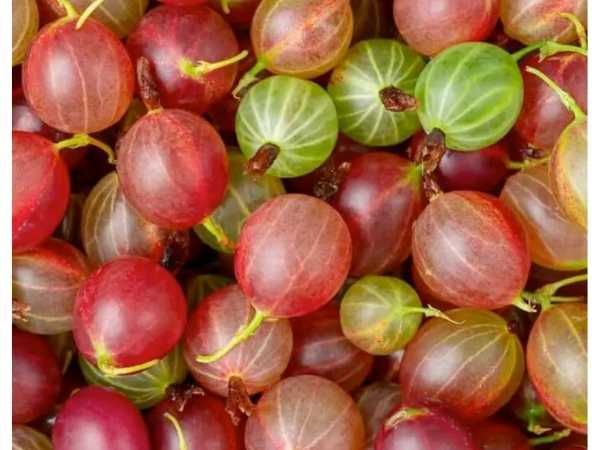
Red Gooseberry / Amla
Phyllanthus emblica
Common Names: Indian Gooseberry, Amla, Amalaki, Emblic Myrobalan
Local Name: Nellikai (Tamil), Amla (Hindi), Nellikka (Malayalam)
Family: Phyllanthaceae
Origin: Indian subcontinent and Southeast Asia
Plant Type: Perennial deciduous tree
Variety: Banarasi, Chakaiya, Francis, NA-7, Krishna — various improved cultivars
Average Lifespan: 50–100+ years
🌿 Botanical Description
| Growth Habit | Medium to large deciduous tree with spreading, drooping branches |
| Plant Size | 8–18 meters tall; canopy spread 6–10 meters |
| Leaves | Small, linear-oblong, 1–2 cm long; closely set on branchlets resembling pinnate leaves |
| Flowers | Tiny, greenish-yellow, in dense clusters along branchlets |
| Flower Characteristics | Monoecious; male and female flowers on same tree; inconspicuous |
| Fruit | Round, 2–4 cm diameter; smooth, hard, with 6 vertical furrows; fibrous, sour-astringent flesh |
| Fruit Color | Light green to yellowish-green; some varieties with reddish tinge |
| Seed Characteristics | Hard, 6-ridged stone containing 6 seeds |
| Root System | Deep taproot with extensive lateral roots; drought-adapted |
☀ Growing Conditions
| Climate | Tropical to subtropical; tolerates semi-arid conditions |
| Temperature Range | 20–40°C ideal; tolerates up to 46°C; light frost tolerance |
| Rainfall Requirement | 500–2500 mm annually; very drought-tolerant |
| Soil Type | Highly adaptable; grows in sandy, loamy, rocky, and even saline soils |
| Soil pH Preference | 5.0–8.0 (very wide range) |
| Sun Requirement | Full sun (6+ hours daily) |
| Spacing | 8–10 meters between trees |
| Irrigation Method | Basin irrigation; minimal once established |
| Water Requirement | Low; extremely drought-tolerant once established |
| Can it Grow in Pots? | Young trees in large pots (40+ liters); will limit size |
🌾 Cultivation & Care
| Fertilizer Schedule | 2–3 times per year; pre-monsoon and post-harvest |
| Recommended Organic Fertilizers | FYM (20–30 kg/tree/year), neem cake, vermicompost, bone meal |
| Pesticide Frequency | Minimal; generally hardy |
| Recommended Organic Pesticides | Neem oil for bark-eating caterpillar; pheromone traps for fruit borer |
| Mulching Practice | Organic mulch around base; leaf litter serves as natural mulch |
| Training System | Modified central leader; open center for mature trees |
| Pruning Time | After harvest (March–April); remove dead wood |
| How to Prune | Remove dead, diseased, and crossing branches; thin canopy for light |
| Common Pests | Bark-eating caterpillar, shoot gall maker, fruit borer, mealy bug |
| Common Diseases | Rust, fruit rot, anthracnose, leaf spot |
| Disease Prevention & Remedies | Good sanitation, copper fungicides, remove fallen fruit, proper spacing |
🌸 Flowering & Fruiting
| Flowering Months | March–May (India) |
| Fruiting Season | October–February; fruits mature in winter |
| Days to Harvest | 180–240 days from flowering |
| Harvest Indicators | Fruit turns yellowish-green, becomes slightly soft; fibrous texture |
| Average Yield per Plant | 50–200 kg per tree (mature); increases with age |
| Pollination Type | Cross-pollination by insects and wind |
| Pollination Notes | Plant 2+ varieties for better fruit set; bees assist pollination |
🌱 Pollination & Propagation
| Pollination Details | Monoecious; cross-pollination improves yield; insects and wind both contribute |
| Propagation by Seeds | Seeds germinate in 2–4 weeks; seedlings take 8–10 years to fruit |
| Propagation by Cuttings | Difficult; air layering possible but not common |
| Propagation by Grafting | Softwood grafting or budding on seedling rootstock (preferred); fruits in 3–4 years |
💧 Environmental Impact & Sustainability
| Water Usage | Very low; one of the most drought-tolerant fruit trees |
| Soil Conservation Practices | Deep roots prevent erosion; grows on degraded and marginal lands |
| Organic Practices Used | Naturally low-input tree; panchagavya, jeevamrutha |
| Companion Plants | Turmeric, ginger, legumes as intercrops; compatible with agroforestry |
| Biodiversity Benefits | Provides food for birds and wildlife; supports forest ecosystem restoration |
💰 Economic Importance
| Commercial Production Regions | India (UP, Rajasthan, Gujarat, Tamil Nadu), Nepal, Sri Lanka |
| Market Uses | Fresh fruit, Ayurvedic medicine, hair oil, health supplements |
| Processing Uses | Amla candy, pickle, juice, powder, Chyawanprash, hair oil, triphala |
| Market Value (Approx.) | ₹30–80 per kg (fresh); processed products much higher value |
🌿 Cultural Significance
| Symbolism | Sacred tree in Hinduism; associated with Lord Vishnu; Amla Navami festival celebrates the tree |
| Traditional Uses | Central to Ayurvedic medicine for millennia; key ingredient in Chyawanprash and Triphala; hair care |
🍈 Nutritional Information
| Calories | 44 kcal per 100g |
| Dietary Fiber | 4.3 g per 100g |
| Vitamin C | 600–900 mg per 100g (one of the highest natural sources) |
| Vitamin A | 290 IU per 100g |
| Iron | 0.31 mg per 100g |
| Potassium | 198 mg per 100g |
| Antioxidants | Extremely high in tannins, gallic acid, ellagic acid, superoxide dismutase |
| Other Key Nutrients | Calcium, phosphorus, chromium, zinc |
🌿 Medicinal Uses
| Anxiety & Sleep | Adaptogenic properties help manage stress; used in Ayurvedic rasayanas |
| Immune Support | Exceptionally high vitamin C; key ingredient in Chyawanprash for immunity |
| Anti-inflammatory Properties | Tannins and gallic acid show potent anti-inflammatory and antioxidant effects |
| Heart Health | May reduce cholesterol and blood pressure; supports arterial health |
| Digestive Health | Key component of Triphala for digestive health; fiber aids regularity |
Disclaimer: Information provided is for educational purposes only and not a substitute for medical advice.
📸 Photo Gallery
📝 Orchard Observation Notes
Add your field observations here.