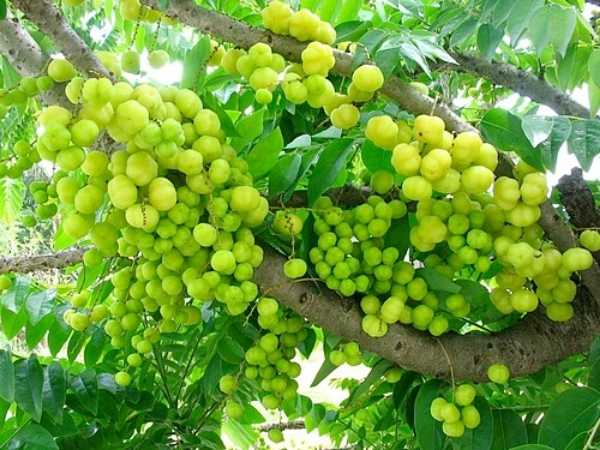
Star Gooseberry
Phyllanthus acidus
Common Names: Star Gooseberry, Otaheite Gooseberry, Malay Gooseberry, Cermai
Local Name: Arunelli (Tamil), Harfarauri (Hindi), Chalmeri (Bengali)
Family: Phyllanthaceae
Origin: Madagascar; widely naturalized in tropical Asia
Plant Type: Perennial deciduous or semi-deciduous tree
Variety: Standard type — pale yellow, ribbed, sour fruit
Average Lifespan: 30–50 years
🌿 Botanical Description
| Growth Habit | Medium-sized tree with dense, spreading crown and drooping branches |
| Plant Size | 5–10 meters tall; canopy spread 4–6 meters |
| Leaves | Alternate, ovate, 2–7 cm long; arranged on deciduous branchlets resembling pinnate leaves |
| Flowers | Tiny, pinkish-red, in dense clusters along older branches and trunk (cauliflorous) |
| Flower Characteristics | Monoecious; male and female flowers in same cluster; inconspicuous |
| Fruit | Small, 1–2.5 cm diameter, oblate with 6–8 ribs; waxy, crisp, very sour flesh |
| Fruit Color | Pale yellow to greenish-white when ripe |
| Seed Characteristics | Single hard, ribbed stone containing 4–6 seeds |
| Root System | Deep taproot with lateral spreading roots |
☀ Growing Conditions
| Climate | Tropical to warm subtropical; frost-sensitive |
| Temperature Range | 25–35°C ideal; does not tolerate frost |
| Rainfall Requirement | 1000–2500 mm annually; tolerates seasonal drought |
| Soil Type | Adaptable; grows in sandy, loamy, or clay soils with good drainage |
| Soil pH Preference | 5.5–7.5 |
| Sun Requirement | Full sun (6+ hours daily) |
| Spacing | 6–8 meters between trees |
| Irrigation Method | Basin irrigation; drought-tolerant once established |
| Water Requirement | Low to moderate; very hardy once established |
| Can it Grow in Pots? | Young trees can be grown in large pots (40+ liters); will limit size |
🌾 Cultivation & Care
| Fertilizer Schedule | 2–3 times per year; pre-monsoon and post-harvest |
| Recommended Organic Fertilizers | FYM, compost, neem cake, bone meal |
| Pesticide Frequency | Minimal; generally pest-resistant |
| Recommended Organic Pesticides | Neem oil for occasional caterpillar or scale infestations |
| Mulching Practice | Organic mulch around base; leaf litter serves as natural mulch |
| Training System | Central leader or natural form |
| Pruning Time | After harvest or during dormancy |
| How to Prune | Remove dead and crossing branches; thin canopy for light penetration |
| Common Pests | Caterpillars, scale insects, fruit borers (generally minimal) |
| Common Diseases | Leaf spot, root rot in waterlogged conditions |
| Disease Prevention & Remedies | Good drainage, avoid waterlogging, remove fallen debris |
🌸 Flowering & Fruiting
| Flowering Months | March–May (tropical regions) |
| Fruiting Season | June–September; fruits in heavy clusters |
| Days to Harvest | 60–90 days from flowering |
| Harvest Indicators | Fruit turns pale yellow, becomes slightly translucent and waxy |
| Average Yield per Plant | 50–100 kg per tree (mature) |
| Pollination Type | Wind and insect pollination |
| Pollination Notes | Monoecious; single tree produces fruit; wind assists pollination |
🌱 Pollination & Propagation
| Pollination Details | Self-fertile monoecious tree; wind and small insects pollinate |
| Propagation by Seeds | Seeds germinate in 2–4 weeks; seedlings fruit in 4–6 years |
| Propagation by Cuttings | Hardwood cuttings possible; air layering more reliable |
| Propagation by Grafting | Air layering preferred for faster fruiting; budding also used |
💧 Environmental Impact & Sustainability
| Water Usage | Low; very drought-tolerant once established |
| Soil Conservation Practices | Deep roots prevent erosion; deciduous leaves enrich soil |
| Organic Practices Used | Minimal inputs needed; naturally hardy tree |
| Companion Plants | Turmeric, ginger, leguminous cover crops as intercrops |
| Biodiversity Benefits | Provides shade and habitat; fruit attracts birds |
💰 Economic Importance
| Commercial Production Regions | India, Southeast Asia, Caribbean, Pacific Islands |
| Market Uses | Fresh fruit, pickles, chutneys, preserves |
| Processing Uses | Pickle, chutney, candied fruit, dried fruit, juice |
| Market Value (Approx.) | ₹40–100 per kg (local markets) |
🌿 Cultural Significance
| Symbolism | Common dooryard tree in tropical villages; symbol of self-sufficiency |
| Traditional Uses | Fruit used in traditional pickles and chutneys; root and bark used in folk medicine for skin conditions |
🍈 Nutritional Information
| Calories | 28 kcal per 100g |
| Dietary Fiber | 0.6 g per 100g |
| Vitamin C | 4.6 mg per 100g |
| Vitamin A | Trace amounts |
| Iron | 0.3 mg per 100g |
| Potassium | 39 mg per 100g |
| Antioxidants | Contains phenolic compounds and flavonoids |
| Other Key Nutrients | Phosphorus, calcium, organic acids |
🌿 Medicinal Uses
| Anxiety & Sleep | Not a primary medicinal use |
| Immune Support | Vitamin C and organic acids support general health |
| Anti-inflammatory Properties | Root extracts used in traditional medicine for inflammation |
| Heart Health | Low calorie fruit; organic acids may support metabolism |
| Digestive Health | Sour fruit stimulates appetite and aids digestion; used for constipation in folk medicine |
Disclaimer: Information provided is for educational purposes only and not a substitute for medical advice.
📸 Photo Gallery
📝 Orchard Observation Notes
Add your field observations here.