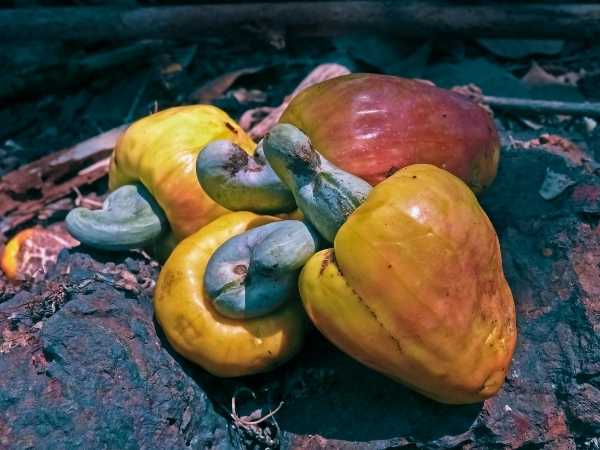
Cashew Nut
Anacardium occidentale
Common Names: Cashew, Cashew Nut, Cashew Apple Tree
Local Name: Mundhiri (Tamil), Kaju (Hindi), Godambi (Kannada)
Family: Anacardiaceae
Origin: Northeastern Brazil; introduced to India by Portuguese in 16th century
Plant Type: Perennial evergreen tree
Variety: Vengurla, BPP-8, Ullal-3 are popular Indian varieties; dwarf and tall types available
Average Lifespan: 30–50+ years
🌿 Botanical Description
| Growth Habit | Spreading evergreen tree with irregular, low-branching canopy |
| Plant Size | 5–12 meters tall; canopy spread 6–10 meters |
| Leaves | Alternate, obovate to elliptic; 10–20 cm long; leathery; glossy dark green; reddish when young |
| Flowers | Small, pale pink to white; 5 petals; borne in terminal panicles; fragrant |
| Flower Characteristics | Hermaphrodite and male flowers on same panicle; bee-pollinated; blooms in dry season |
| Fruit | True fruit is the kidney-shaped nut (drupe) attached to the base of the cashew apple (pseudofruit); nut 2–4 cm |
| Fruit Color | Cashew apple: yellow to red; nut shell: grey-green turning grey when dry |
| Seed Characteristics | One seed (cashew kernel) per nut; enclosed in double shell containing caustic CNSL oil |
| Root System | Deep taproot with extensive laterals; very drought-tolerant |
☀ Growing Conditions
| Climate | Tropical; hot, humid coastal climate ideal; needs dry season for flowering |
| Temperature Range | 20–35°C; frost-sensitive; optimal 25–30°C |
| Rainfall Requirement | 600–4500 mm; dry season (3–4 months) needed for flowering and fruiting |
| Soil Type | Well-drained sandy loam to laterite; tolerates poor, acidic soils; dislikes waterlogging |
| Soil pH Preference | 5.0–6.5; prefers slightly acidic soils |
| Sun Requirement | Full sun (6+ hours daily) |
| Spacing | 7–10 meters between trees |
| Irrigation Method | Drip or basin; minimal irrigation needed; avoid during flowering |
| Water Requirement | Low; drought-tolerant; excess moisture during flowering reduces yield |
| Can it Grow in Pots? | Not recommended; large tree requires open ground |
🌾 Cultivation & Care
| Fertilizer Schedule | 2–3 times per year; pre-flowering, post-harvest; young trees monthly |
| Recommended Organic Fertilizers | FYM, vermicompost, neem cake, wood ash, bone meal |
| Pesticide Frequency | Monthly during flowering and fruiting season |
| Recommended Organic Pesticides | Neem oil for tea mosquito bug and thrips; copper fungicide for anthracnose |
| Mulching Practice | Heavy organic mulch around base; helps retain moisture in dry season |
| Training System | Allow natural spreading form; remove low-hanging branches for access |
| Pruning Time | After harvest (May–June); remove dead and crossing branches |
| How to Prune | Light pruning to open canopy; remove dead wood; avoid heavy pruning |
| Common Pests | Tea mosquito bug (Helopeltis), thrips, stem and root borer, leaf miner |
| Common Diseases | Anthracnose, powdery mildew, die-back, root rot |
| Disease Prevention & Remedies | Copper fungicide for anthracnose; neem oil for pests; good drainage; remove infected material |
🌸 Flowering & Fruiting
| Flowering Months | November–February (India); triggered by dry season |
| Fruiting Season | February–May; cashew apples and nuts ripen together |
| Days to Harvest | 60–70 days from flowering to nut maturity |
| Harvest Indicators | Cashew apple turns yellow/red; nut falls naturally; apple is soft and fragrant |
| Average Yield per Plant | 8–20 kg nuts per tree (mature); 50–100 kg cashew apples |
| Pollination Type | Insect-pollinated (bees, flies); self-fertile |
| Pollination Notes | Self-fertile; bee pollination improves yield; single tree produces fruit |
🌱 Pollination & Propagation
| Pollination Details | Bee and fly pollinated; self-fertile; cross-pollination improves yield |
| Propagation by Seeds | Seeds germinate in 2–4 weeks; may not come true to variety; fruits in 3–5 years |
| Propagation by Cuttings | Air layering is more reliable than cuttings |
| Propagation by Grafting | Softwood grafting on seedling rootstock; preferred for improved varieties; fruits in 2–3 years |
💧 Environmental Impact & Sustainability
| Water Usage | Very low; drought-tolerant; suitable for coastal and semi-arid regions |
| Soil Conservation Practices | Grows on poor laterite soils; prevents coastal erosion; reclaims wasteland |
| Organic Practices Used | Minimal inputs; naturally robust; leaf litter improves soil |
| Companion Plants | Pineapple, banana as intercrops; leguminous cover crops |
| Biodiversity Benefits | Flowers attract bees; cashew apple feeds birds and bats; supports coastal ecosystem |
💰 Economic Importance
| Commercial Production Regions | India (Goa, Kerala, Maharashtra, AP), Vietnam, Ivory Coast, Brazil |
| Market Uses | Cashew kernels (premium nut), cashew apple juice, feni (liquor), CNSL (industrial) |
| Processing Uses | Roasted cashews, cashew butter, cashew milk, cashew apple juice, feni, CNSL for industrial use |
| Market Value (Approx.) | ₹600–1200 per kg kernels; ₹80–150 per kg raw nuts; grafted plants ₹200–500 |
🌿 Cultural Significance
| Symbolism | Important cash crop in coastal India; integral to Goan culture and cuisine |
| Traditional Uses | Cashew apple used for feni (traditional Goan liquor); bark used in traditional medicine for toothache; CNSL for waterproofing |
🍈 Nutritional Information
| Calories | 553 kcal per 100g (kernel) |
| Dietary Fiber | 3.3 g per 100g |
| Vitamin C | 0.5 mg per 100g (kernel); cashew apple has 261 mg/100g |
| Potassium | 660 mg per 100g |
| Antioxidants | Anacardic acid, cardanol, tocopherols; antioxidant-rich |
| Other Key Nutrients | Magnesium, zinc, iron, copper, vitamin K, vitamin B6, healthy monounsaturated fats |
🌿 Medicinal Uses
| Heart Health | Monounsaturated fats support cardiovascular health; reduces LDL cholesterol |
| Anti-inflammatory Properties | Anacardic acid shows anti-inflammatory and antimicrobial activity |
| Immune Support | Zinc and copper support immune function |
Disclaimer: Information provided is for educational purposes only and not a substitute for medical advice.
📝 Orchard Observation Notes
Add your field observations here.