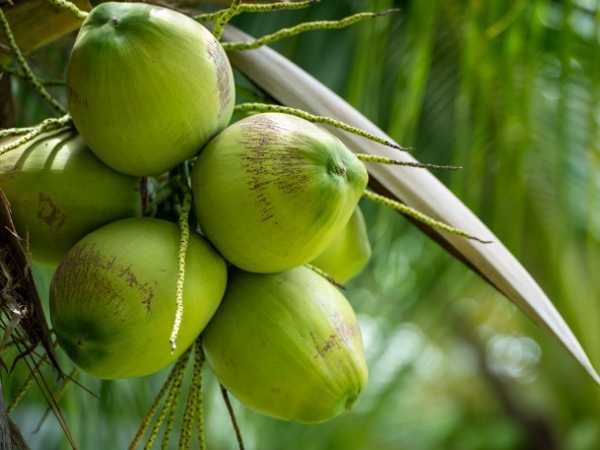
Coconut
Cocos nucifera
Common Names: Coconut, Coconut Palm, Coco
Local Name: Thennai (Tamil), Nariyal (Hindi), Thengu (Malayalam)
Family: Arecaceae
Origin: Indo-Malayan region
Plant Type: Perennial palm tree, 20–30 meters tall
Variety: Tall, Dwarf, and Hybrid varieties
Average Lifespan: 60–100 years
🌿 Botanical Description
| Growth Habit | Tall, unbranched, single-stemmed palm with terminal crown of leaves |
| Plant Size | 20–30 meters tall (Tall variety); 5–10 meters (Dwarf variety) |
| Leaves | Pinnately compound, 4–6 meters long with 200+ leaflets; spirally arranged crown of 25–35 fronds |
| Flowers | Monoecious; small yellow flowers in branched spadix enclosed in a woody spathe |
| Flower Characteristics | Male flowers numerous and small at branch tips; female flowers larger and fewer at base of spadix |
| Fruit | Large drupe, 20–30 cm long; fibrous husk (mesocarp), hard shell (endocarp), white meat (endosperm), and coconut water |
| Fruit Color | Green when immature, turning brown when mature |
| Seed Characteristics | Single large seed; the coconut itself is the seed with endosperm (white meat) and liquid endosperm (coconut water) |
| Root System | Fibrous adventitious root system arising from the bole; no taproot; roots spread 2–4 meters laterally |
☀ Growing Conditions
| Climate | Tropical; thrives in humid coastal regions |
| Temperature Range | 20–32°C ideal; does not tolerate frost or temperatures below 12°C |
| Rainfall Requirement | 1500–2500 mm annually; well-distributed throughout the year |
| Soil Type | Sandy loam, laterite, or alluvial soils with good drainage |
| Soil pH Preference | 5.5–7.0 |
| Sun Requirement | Full sun (8+ hours daily); intolerant of shade |
| Spacing | 7.5–9 meters between palms (triangular planting) |
| Irrigation Method | Basin irrigation or drip irrigation; husk burial in basins improves moisture retention |
| Water Requirement | High; 30–40 liters per palm per day in dry season |
| Can it Grow in Pots? | Dwarf varieties can be grown in very large containers (100+ liters) but will limit yield significantly |
🌾 Cultivation & Care
| Fertilizer Schedule | Twice yearly — pre-monsoon (June) and post-monsoon (December) |
| Recommended Organic Fertilizers | FYM (25–50 kg/palm/year), green manure, neem cake, bone meal, wood ash |
| Pesticide Frequency | Preventive treatment 2–3 times per year; monitor crown regularly |
| Recommended Organic Pesticides | Neem oil, neem cake in basin, pheromone traps for rhinoceros beetle |
| Mulching Practice | Coconut husk, coir pith, or dried fronds around the basin |
| Training System | Not applicable — single-stemmed palm; remove dead fronds regularly |
| Pruning Time | Year-round removal of dried fronds and spent bunches |
| How to Prune | Remove dead and hanging fronds; cut spent flower bunches; keep crown clean to prevent pest harborage |
| Common Pests | Rhinoceros beetle, red palm weevil, coconut mite, black-headed caterpillar |
| Common Diseases | Bud rot, stem bleeding, leaf blight, root wilt (Kerala wilt) |
| Disease Prevention & Remedies | Good drainage, crown cleaning, Bordeaux paste on wounds, biocontrol agents (Metarhizium) |
🌸 Flowering & Fruiting
| Flowering Months | Year-round in tropical conditions; produces 12–14 spadices per year |
| Fruiting Season | Year-round; continuous production once mature |
| Days to Harvest | 11–12 months from pollination for mature coconut; 6–7 months for tender coconut |
| Harvest Indicators | Mature: brown husk, sloshing water sound; Tender: green, 6–7 months old |
| Average Yield per Plant | 60–100 nuts per palm per year (Tall); 80–150 (Dwarf/Hybrid) |
| Pollination Type | Cross-pollination predominantly (Tall); self-pollination common in Dwarf varieties |
| Pollination Notes | Wind and insects (bees, ants) are primary pollinators; male flowers open before female (protandry) |
💰 Economic Importance
| Commercial Production Regions | Indonesia, Philippines, India (Kerala, Tamil Nadu, Karnataka), Sri Lanka, Brazil |
| Market Uses | Fresh coconut, copra, coconut oil, coconut water, coir fiber, shell charcoal |
| Processing Uses | Coconut oil, desiccated coconut, coconut milk, coconut cream, virgin coconut oil, activated carbon from shells |
| Market Value (Approx.) | ₹15–40 per nut; copra ₹80–150 per kg; coconut oil ₹150–250 per liter |
🍈 Nutritional Information
| Calories | 354 kcal per 100g (fresh meat) |
| Dietary Fiber | 9 g per 100g |
| Vitamin C | 3.3 mg per 100g |
| Vitamin A | Negligible |
| Iron | 2.4 mg per 100g |
| Potassium | 356 mg per 100g |
| Antioxidants | Phenolic compounds, gallic acid, caffeic acid |
| Other Key Nutrients | Manganese (60% DV), copper, selenium, medium-chain triglycerides (MCTs) |
🌿 Medicinal Uses
| Immune Support | Lauric acid in coconut oil has antimicrobial and antiviral properties |
| Anti-inflammatory Properties | Virgin coconut oil shows anti-inflammatory and analgesic effects in studies |
| Heart Health | MCTs may raise HDL cholesterol; coconut water is rich in electrolytes |
| Digestive Health | High fiber content aids digestion; coconut water helps rehydration |
| Skin & Hair Care | Coconut oil widely used as moisturizer, hair oil, and in traditional Ayurvedic treatments |
Disclaimer: Information provided is for educational purposes only and not a substitute for medical advice.
📸 Photo Gallery
📝 Orchard Observation Notes
Add your field observations here.