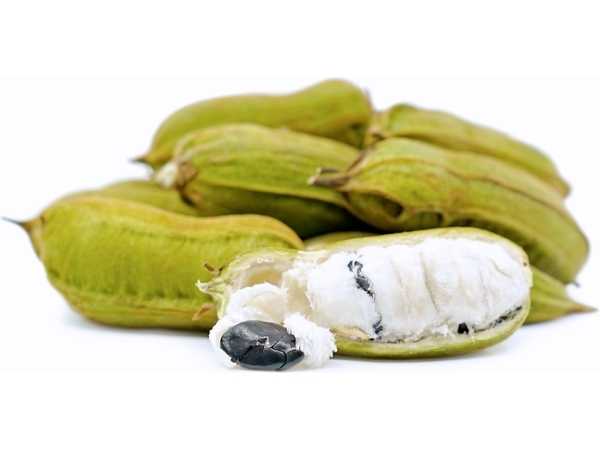
Ice Cream Bean
Inga edulis
Common Names: Ice Cream Bean, Guaba, Guama, Joaquiniquil, Pacay
Local Name: Guaba (Spanish), Ingá-cipó (Portuguese)
Family: Fabaceae
Origin: Central and South America (Amazon Basin to Central America)
Plant Type: Perennial evergreen tree
Variety: Several Inga species cultivated; I. edulis most common
Average Lifespan: 30–50 years
🌿 Botanical Description
| Growth Habit | Fast-growing evergreen tree with broad spreading canopy |
| Plant Size | 10–30 meters tall; wide spreading crown up to 15 meters |
| Leaves | Pinnately compound, 4–6 pairs of leaflets with winged rachis, 20–30 cm long |
| Flowers | White, tubular, with prominent stamens, borne in axillary spikes |
| Flower Characteristics | Fragrant; numerous white stamens give brush-like appearance; attract hummingbirds and bees |
| Fruit | Very long cylindrical pod, 30–100 cm long, containing seeds embedded in sweet white cottony pulp |
| Fruit Color | Green pod; white cotton-like sweet pulp inside |
| Seed Characteristics | Large black seeds, 2–3 cm, embedded in sweet aril; recalcitrant |
| Root System | Deep taproot with extensive lateral roots; nitrogen-fixing nodules |
☀ Growing Conditions
| Climate | Tropical lowland to mid-elevation; frost-intolerant |
| Temperature Range | 20–35°C ideal; does not tolerate frost |
| Rainfall Requirement | 1500–3000 mm annually; tolerates wet conditions |
| Soil Type | Adaptable; grows in poor acidic soils; prefers well-drained loam |
| Soil pH Preference | 4.5–7.0 (very adaptable) |
| Sun Requirement | Full sun; fast growth in open conditions |
| Spacing | 8–12 meters between trees |
| Irrigation Method | Rain-fed in tropics; supplemental watering in dry periods |
| Water Requirement | Moderate; tolerates both wet and moderately dry conditions |
| Can it Grow in Pots? | Not recommended — very fast-growing and large |
🌾 Cultivation & Care
| Fertilizer Schedule | Minimal; nitrogen-fixing roots reduce fertilizer needs |
| Recommended Organic Fertilizers | Compost, phosphorus supplements; nitrogen rarely needed |
| Pesticide Frequency | Rarely needed; naturally pest-resistant |
| Recommended Organic Pesticides | Neem oil if needed |
| Mulching Practice | Self-mulching from abundant leaf litter; excellent for soil improvement |
| Training System | Natural spreading form; used as shade tree in agroforestry |
| Pruning Time | Regular pollarding for agroforestry; after fruiting for fruit production |
| How to Prune | Pollard or coppice for mulch production; light pruning for fruit trees |
| Common Pests | Pod borers, psyllids (minimal impact) |
| Common Diseases | Generally disease-free; occasional leaf spot |
| Disease Prevention & Remedies | Good air circulation; rarely needs treatment |
🌸 Flowering & Fruiting
| Flowering Months | Year-round in tropics; peaks during rainy season |
| Fruiting Season | Year-round with peaks; pods mature 3–4 months after flowering |
| Days to Harvest | 90–120 days from flowering |
| Harvest Indicators | Pods become plump, slightly soft; green colour may lighten |
| Average Yield per Plant | 50–100 kg of pods per tree per year |
| Pollination Type | Insect and hummingbird pollination |
| Pollination Notes | Hummingbirds, bees, and moths are primary pollinators; night-blooming attracts moths |
🌱 Pollination & Propagation
| Pollination Details | Cross-pollination by hummingbirds and insects; some self-fertility |
| Propagation by Seeds | Fresh seeds germinate in 1–2 weeks; must be sown immediately (recalcitrant); very fast growth |
| Propagation by Cuttings | Large hardwood cuttings possible; air layering also works |
| Propagation by Grafting | Not commonly grafted; seedlings grow fast and fruit in 3–4 years |
💧 Environmental Impact & Sustainability
| Water Usage | Moderate; adapted to tropical rainfall |
| Soil Conservation Practices | Exceptional nitrogen fixer; improves degraded soils; heavy leaf litter builds humus |
| Organic Practices Used | Key agroforestry species; provides shade, mulch, and nitrogen to companion crops |
| Companion Plants | Cacao, coffee, vanilla — classic agroforestry shade tree |
| Biodiversity Benefits | Attracts hummingbirds, bees, moths; provides habitat; improves soil for entire ecosystem |
💰 Economic Importance
| Commercial Production Regions | Peru, Brazil, Colombia, Ecuador, Central America |
| Market Uses | Fresh fruit (street food), shade tree, firewood, timber |
| Processing Uses | Eaten fresh; pulp used in beverages; wood for fuel and construction |
| Market Value (Approx.) | $1–3 per pod (local markets); valued more for agroforestry services |
🌿 Cultural Significance
| Symbolism | Symbol of sustainable agroforestry; important in Amazonian food culture |
| Traditional Uses | Sweet pulp eaten fresh as snack; widely sold in Latin American markets; shade tree for cacao and coffee |
🍈 Nutritional Information
| Calories | 50–60 kcal per 100g of pulp |
| Dietary Fiber | 1.0 g per 100g |
| Vitamin C | Moderate amounts |
| Vitamin A | Trace amounts |
| Iron | 0.3 mg per 100g |
| Potassium | Present |
| Antioxidants | Phenolic compounds present |
| Other Key Nutrients | Calcium, phosphorus, natural sugars |
🌿 Medicinal Uses
| Anxiety & Sleep | Not documented |
| Immune Support | Moderate vitamin C supports immunity |
| Anti-inflammatory Properties | Bark used in traditional medicine for inflammation |
| Heart Health | Low-fat, natural sugar source |
| Digestive Health | Bark decoction used traditionally for diarrhoea |
Disclaimer: Information provided is for educational purposes only and not a substitute for medical advice.
📸 Photo Gallery
📝 Orchard Observation Notes
Add your field observations here.