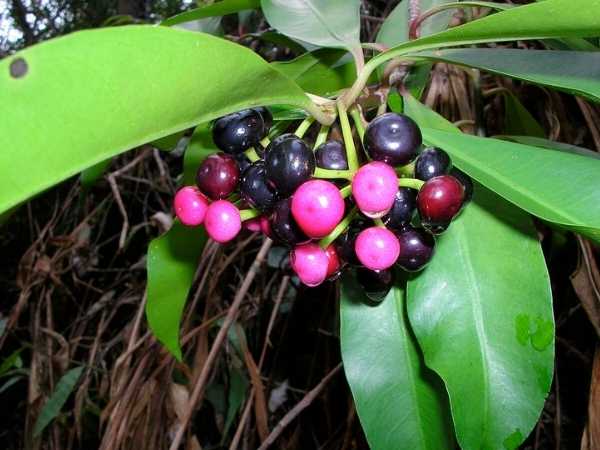
Jamun Killi Naval
Ardisia elliptica 'Killi Naval'
Common Names: Killi Naval, Jamun, Java Plum, Black Plum
Local Name: Killi Naval Pazham (Tamil), Jamun (Hindi)
Family: Myrtaceae
Origin: Indian subcontinent; Tamil Nadu selection
Plant Type: Perennial evergreen tree
Variety: Killi Naval — Tamil Nadu local variety with small, sweet, intensely colored fruit
Average Lifespan: 60–100+ years
🌿 Botanical Description
| Growth Habit | Large evergreen tree with dense, spreading canopy |
| Plant Size | 10–20 meters tall; canopy spread 8–15 meters |
| Leaves | Opposite, simple, elliptic-oblong, 8–15 cm long; leathery, glossy dark green |
| Flowers | Small, fragrant, white to pinkish, in clusters at branch tips |
| Flower Characteristics | Numerous stamens give brush-like appearance; fragrant; attract bees |
| Fruit | Oblong drupe, 1.5–2.5 cm long; thin skin, juicy purple pulp, astringent-sweet |
| Fruit Color | Deep purple to black when ripe; stains tongue and teeth purple |
| Seed Characteristics | Single large seed (50% of fruit); green, oblong |
| Root System | Deep taproot with extensive lateral roots; very stable |
☀ Growing Conditions
| Climate | Tropical to subtropical; thrives in hot, humid conditions |
| Temperature Range | 25–38°C ideal; tolerates up to 45°C; frost-sensitive |
| Rainfall Requirement | 800–2500 mm annually; tolerates seasonal drought |
| Soil Type | Adaptable; prefers deep alluvial or loamy soil; tolerates waterlogging |
| Soil pH Preference | 5.5–8.0 |
| Sun Requirement | Full sun (6+ hours daily) |
| Spacing | 8–12 meters between trees |
| Irrigation Method | Basin irrigation; minimal once established |
| Water Requirement | Low to moderate; drought-tolerant once established |
| Can it Grow in Pots? | Young trees in very large pots (50+ liters); not ideal long-term |
🌾 Cultivation & Care
| Fertilizer Schedule | 2–3 times per year; pre-monsoon and post-harvest |
| Recommended Organic Fertilizers | FYM (25–50 kg/tree/year), neem cake, vermicompost |
| Pesticide Frequency | Minimal; generally pest-resistant |
| Recommended Organic Pesticides | Neem oil for leaf miner; fruit fly traps during fruiting |
| Mulching Practice | Organic mulch around base; leaf litter provides natural mulch |
| Training System | Modified central leader; natural form for mature trees |
| Pruning Time | After harvest (August–September) |
| How to Prune | Remove dead and crossing branches; thin canopy for light and air |
| Common Pests | Leaf miner, fruit fly, white fly, bark borer |
| Common Diseases | Leaf spot, anthracnose, sooty mold, dieback |
| Disease Prevention & Remedies | Good sanitation, copper fungicides, remove infected parts |
🌸 Flowering & Fruiting
| Flowering Months | March–May (South India) |
| Fruiting Season | June–August; coincides with monsoon |
| Days to Harvest | 60–90 days from flowering |
| Harvest Indicators | Fruit turns deep purple-black, softens, and develops sweet-astringent flavor |
| Average Yield per Plant | 50–150 kg per tree (mature) |
| Pollination Type | Cross-pollination by insects (bees, flies) |
| Pollination Notes | Self-fertile but cross-pollination improves yield; bees are primary pollinators |
🌱 Pollination & Propagation
| Pollination Details | Insect-pollinated; fragrant flowers attract bees and flies |
| Propagation by Seeds | Seeds germinate in 1–2 weeks (polyembryonic); seedlings fruit in 8–10 years |
| Propagation by Cuttings | Difficult; air layering possible but slow |
| Propagation by Grafting | Softwood grafting or veneer grafting on seedling rootstock; fruits in 4–5 years |
💧 Environmental Impact & Sustainability
| Water Usage | Low; very drought-tolerant once established |
| Soil Conservation Practices | Deep roots prevent erosion; excellent for riverbank stabilization |
| Organic Practices Used | Minimal inputs needed; naturally hardy |
| Companion Plants | Shade-tolerant crops, turmeric, ginger as intercrops |
| Biodiversity Benefits | Fruit feeds birds, bats, and wildlife; large canopy provides habitat |
💰 Economic Importance
| Commercial Production Regions | Tamil Nadu, Karnataka, Andhra Pradesh, Maharashtra, UP |
| Market Uses | Fresh fruit, juice, vinegar, wine |
| Processing Uses | Juice, vinegar, wine, jam, seed powder (diabetes supplement) |
| Market Value (Approx.) | ₹40–120 per kg (seasonal) |
🌿 Cultural Significance
| Symbolism | Sacred tree in Hinduism; associated with Lord Krishna; planted near temples |
| Traditional Uses | Fruit, bark, and seeds used in Ayurveda and Siddha medicine; seed powder for diabetes management |
🍈 Nutritional Information
| Calories | 60 kcal per 100g |
| Dietary Fiber | 0.9 g per 100g |
| Vitamin C | 18 mg per 100g |
| Vitamin A | 3 IU per 100g |
| Iron | 1.2 mg per 100g |
| Potassium | 79 mg per 100g |
| Antioxidants | Rich in anthocyanins, ellagic acid, gallic acid |
| Other Key Nutrients | Calcium, phosphorus, jamboline (seed alkaloid) |
🌿 Medicinal Uses
| Anxiety & Sleep | Not a primary use |
| Immune Support | Vitamin C and anthocyanins support immune function |
| Anti-inflammatory Properties | Bark and seed extracts show anti-inflammatory activity |
| Heart Health | Anthocyanins support cardiovascular health; may help regulate blood pressure |
| Digestive Health | Astringent properties aid digestion; bark decoction used for diarrhea |
Disclaimer: Information provided is for educational purposes only and not a substitute for medical advice.
📸 Photo Gallery
📝 Orchard Observation Notes
Add your field observations here.