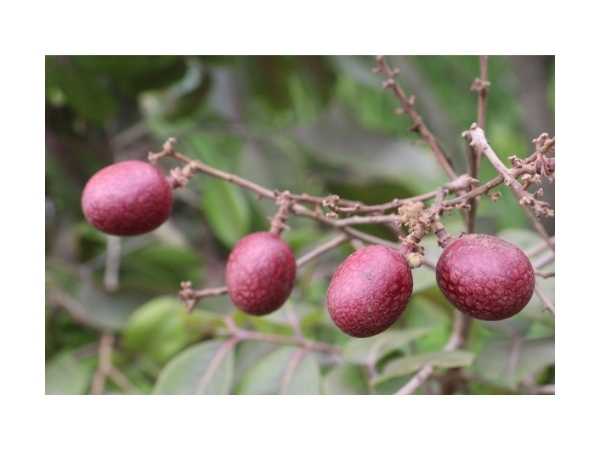
Longan - Ruby
Dimocarpus longan 'Ruby'
Common Names: Ruby Longan, Red Longan, Red Dragon Eye
Local Name: Puvatti Pazham (Tamil), Longan (Hindi/English)
Family: Sapindaceae
Origin: Southeast Asia (rare cultivar selected for red skin pigmentation)
Plant Type: Perennial evergreen tree
Variety: Ruby — distinctive red to reddish-brown skinned longan with sweet, aromatic flesh
Average Lifespan: 40–60+ years
🌿 Botanical Description
| Growth Habit | Medium evergreen tree with dense, rounded canopy |
| Plant Size | 6–12 meters tall; canopy spread 5–8 meters |
| Leaves | Alternate, pinnately compound, 4–8 pairs of leaflets, dark green, leathery; new growth may show reddish tinge |
| Flowers | Small, yellowish-white, in terminal panicles; functionally male, female, and bisexual |
| Flower Characteristics | Fragrant; attracts bees; requires cool period for flower induction |
| Fruit | Round, 2–3 cm diameter; distinctive red to reddish-brown shell; translucent sweet flesh |
| Fruit Color | Red to reddish-brown shell (unique among longan varieties); translucent white to pinkish flesh |
| Seed Characteristics | Single round, shiny dark seed; not edible |
| Root System | Moderately deep with spreading lateral roots |
☀ Growing Conditions
| Climate | Tropical to warm subtropical; needs brief cool period for flowering |
| Temperature Range | 20–32°C ideal; needs cool nights (10–15°C) for flower induction; frost-sensitive |
| Rainfall Requirement | 1200–2000 mm annually |
| Soil Type | Well-drained sandy loam to loam; rich in organic matter |
| Soil pH Preference | 5.5–6.5 |
| Sun Requirement | Full sun (6–8 hours daily); good light enhances red coloration |
| Spacing | 6–8 meters between trees |
| Irrigation Method | Drip irrigation; reduce watering before flowering |
| Water Requirement | Moderate; consistent moisture during fruit development |
| Can it Grow in Pots? | Yes, in large containers (50+ liters); may fruit with proper care |
🌾 Cultivation & Care
| Fertilizer Schedule | 3–4 times per year; extra potassium for color development |
| Recommended Organic Fertilizers | Compost, vermicompost, fish emulsion, bone meal, wood ash (potassium) |
| Pesticide Frequency | Monitor monthly; treat during flowering and fruiting |
| Recommended Organic Pesticides | Neem oil, insecticidal soap, pyrethrin |
| Mulching Practice | Organic mulch (5–8 cm) to retain moisture and suppress weeds |
| Training System | Open center; maintain accessible canopy |
| Pruning Time | After harvest; tip-prune to encourage flowering wood |
| How to Prune | Remove dead wood; tip-prune new growth; thin interior for light penetration (enhances red color) |
| Common Pests | Longan stink bug, fruit borer, mites, scale insects |
| Common Diseases | Witches' broom, leaf spot, fruit rot, powdery mildew |
| Disease Prevention & Remedies | Good air circulation, copper fungicides, sanitation, remove infected material |
🌸 Flowering & Fruiting
| Flowering Months | February–April (after cool period) |
| Fruiting Season | June–September |
| Days to Harvest | 130–160 days from flowering |
| Harvest Indicators | Shell develops full red-brown color, flesh becomes translucent and sweet, fruit detaches easily |
| Average Yield per Plant | 25–60 kg per tree per year (mature); slightly lower yield than standard varieties |
| Pollination Type | Cross-pollination and self-pollination |
| Pollination Notes | Benefits from cross-pollination with other longan varieties; bees are primary pollinators |
🌱 Pollination & Propagation
| Pollination Details | Produces male and bisexual flowers; cross-pollination improves fruit set |
| Propagation by Seeds | Seeds germinate easily but red-skin trait may not be reliably inherited |
| Propagation by Cuttings | Air layering (marcotting) effective; maintains red-skin trait |
| Propagation by Grafting | Cleft or veneer grafting on seedling rootstock; essential to maintain Ruby characteristics |
💧 Environmental Impact & Sustainability
| Water Usage | Moderate; efficient with drip irrigation |
| Soil Conservation Practices | Evergreen canopy provides year-round cover; mulching prevents erosion |
| Organic Practices Used | Composting, biological pest control, cover cropping |
| Companion Plants | Leguminous cover crops, lemongrass, marigolds |
| Biodiversity Benefits | Flowers attract pollinators; fruit eaten by birds and bats |
💰 Economic Importance
| Commercial Production Regions | Thailand, Vietnam, China (limited); specialty/collector market worldwide |
| Market Uses | Premium fresh fruit; novelty/specialty market; ornamental value |
| Processing Uses | Dried longan, fresh consumption; primarily sold as premium fresh fruit |
| Market Value (Approx.) | ₹400–800 per kg; commands premium due to rarity and unique appearance |
🌿 Cultural Significance
| Symbolism | Red color considered auspicious in Asian cultures; "Red Dragon Eye" is a collector's fruit |
| Traditional Uses | Same TCM uses as standard longan; red variety considered especially potent as blood tonic |
🍈 Nutritional Information
| Calories | 60 kcal per 100g |
| Dietary Fiber | 1.1 g per 100g |
| Vitamin C | 84 mg per 100g (140% DV) |
| Vitamin A | Trace amounts; red skin contains additional anthocyanins |
| Iron | 0.13 mg per 100g |
| Potassium | 266 mg per 100g |
| Antioxidants | Anthocyanins (in red skin), gallic acid, ellagic acid, polyphenols |
| Other Key Nutrients | Riboflavin, niacin, copper, manganese |
🌿 Medicinal Uses
| Anxiety & Sleep | Dried longan used in TCM as calming agent and sleep aid |
| Immune Support | High vitamin C and anthocyanins support immune function |
| Anti-inflammatory Properties | Anthocyanins and polyphenols show enhanced anti-inflammatory activity |
| Heart Health | Anthocyanins and potassium support cardiovascular health |
| Digestive Health | Traditionally used to strengthen spleen and stomach in TCM |
Disclaimer: Information provided is for educational purposes only and not a substitute for medical advice.
📸 Photo Gallery
📝 Orchard Observation Notes
Add your field observations here.