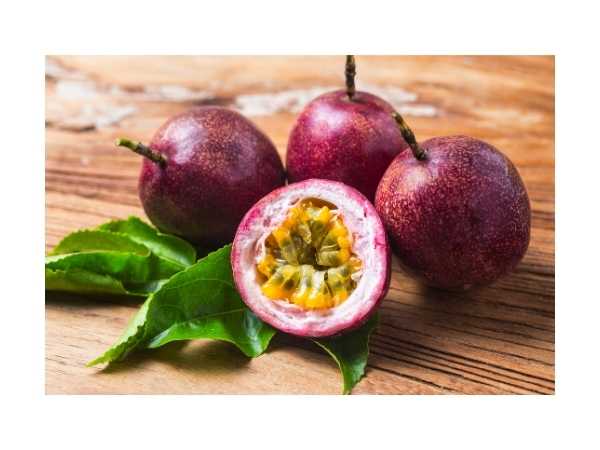
Passion Fruit
Passiflora edulis
Common Names: Passion Fruit, Purple Granadilla, Maracuja
Local Name: Krishna Phal (Hindi), Thokkudu Pandu (Telugu)
Family: Passifloraceae
Origin: Southern Brazil, Paraguay, Northern Argentina
Plant Type: Perennial climbing vine
Variety: Purple (Passiflora edulis) and Yellow (Passiflora edulis f. flavicarpa)
Average Lifespan: 5–7 years
🌿 Botanical Description
| Growth Habit | Vigorous climbing vine with tendrils, can grow 15–20 feet per year |
| Plant Size | Vine length up to 10–15 meters |
| Leaves | Alternate, deeply 3-lobed, serrated edges, 7–20 cm long, glossy dark green |
| Flowers | Striking 5–7 cm diameter, white petals with purple-blue corona filaments |
| Flower Characteristics | Fragrant, complex structure with 5 stamens and 3 stigmas; blooms for only one day |
| Fruit | Round to oval, 4–8 cm diameter, thick rind enclosing juicy pulp with seeds |
| Fruit Color | Purple to dark purple when ripe (purple variety); yellow when ripe (yellow variety) |
| Seed Characteristics | Small, black, hard-coated seeds surrounded by aromatic orange pulp |
| Root System | Shallow, fibrous root system; sensitive to waterlogging |
☀ Growing Conditions
| Climate | Tropical to subtropical; frost-sensitive |
| Temperature Range | 20–30°C ideal; can tolerate brief periods down to 2°C |
| Rainfall Requirement | 900–2000 mm annually; well-distributed |
| Soil Type | Well-drained sandy loam to loam; rich in organic matter |
| Soil pH Preference | 6.0–6.5 |
| Sun Requirement | Full sun (6+ hours daily) |
| Spacing | 3–5 meters between plants; needs trellis support |
| Irrigation Method | Drip irrigation preferred; consistent moisture needed |
| Water Requirement | Moderate to high; avoid waterlogging |
| Can it Grow in Pots? | Yes, in large containers (20+ liters) with trellis support |
🌾 Cultivation & Care
| Fertilizer Schedule | Every 4–6 weeks during growing season; reduce in winter |
| Recommended Organic Fertilizers | Compost, well-rotted manure, bone meal, seaweed extract |
| Pesticide Frequency | As needed; monitor regularly for pests |
| Recommended Organic Pesticides | Neem oil, pyrethrin spray, insecticidal soap |
| Mulching Practice | Thick organic mulch (5–10 cm) to retain moisture and suppress weeds |
| Training System | Trellis or pergola system; train main stem vertically, laterals horizontally |
| Pruning Time | After harvest season; early spring |
| How to Prune | Remove dead/weak growth; cut back laterals to 30 cm from main stem |
| Common Pests | Fruit fly, aphids, mealybugs, spider mites, passion vine hopper |
| Common Diseases | Fusarium wilt, brown spot, woodiness virus, collar rot |
| Disease Prevention & Remedies | Good drainage, crop rotation, resistant rootstocks, remove infected plants promptly |
🌸 Flowering & Fruiting
| Flowering Months | Spring to early autumn (varies by region) |
| Fruiting Season | Summer to autumn; 60–80 days after flowering |
| Days to Harvest | 60–80 days from pollination |
| Harvest Indicators | Fruit turns fully colored and drops from vine; slight wrinkling of skin |
| Average Yield per Plant | 15–20 kg per year (mature vine) |
| Pollination Type | Cross-pollination required (purple variety); self-fertile (yellow variety) |
| Pollination Notes | Carpenter bees are primary pollinators; hand pollination improves yield |
🌱 Pollination & Propagation
| Pollination Details | Flowers open for one day only; pollination must occur within hours of opening |
| Propagation by Seeds | Fresh seeds germinate in 10–20 days; soak 24 hours before sowing |
| Propagation by Cuttings | Semi-hardwood cuttings with 3–4 nodes; root in 3–4 weeks |
| Propagation by Grafting | Wedge grafting onto disease-resistant rootstock for commercial production |
💧 Environmental Impact & Sustainability
| Water Usage | Moderate; efficient with drip irrigation |
| Soil Conservation Practices | Ground cover beneath vines; mulching prevents erosion |
| Organic Practices Used | Compost tea, companion planting, biological pest control |
| Companion Plants | Marigolds, basil, beans (nitrogen fixers) |
| Biodiversity Benefits | Attracts pollinators; flowers support carpenter bees and butterflies |
💰 Economic Importance
| Commercial Production Regions | Brazil, Colombia, Ecuador, Kenya, India, Australia |
| Market Uses | Fresh fruit, juice, pulp concentrate |
| Processing Uses | Juice, jam, ice cream flavoring, cocktails, desserts |
| Market Value (Approx.) | ₹80–200 per kg (India); varies by season and region |
🌿 Cultural Significance
| Symbolism | Named by Spanish missionaries who saw the flower as a symbol of the Passion of Christ |
| Traditional Uses | Leaves used in traditional medicine for anxiety and insomnia; fruit in beverages |
🍈 Nutritional Information
| Calories | 97 kcal per 100g |
| Dietary Fiber | 10.4 g per 100g |
| Vitamin C | 30 mg per 100g (50% DV) |
| Vitamin A | 1274 IU per 100g |
| Iron | 1.6 mg per 100g |
| Potassium | 348 mg per 100g |
| Antioxidants | Rich in polyphenols, carotenoids, and flavonoids |
| Other Key Nutrients | Riboflavin, niacin, phosphorus, magnesium |
🌿 Medicinal Uses
| Anxiety & Sleep | Leaf extract (Passiflora incarnata) used as mild sedative and anxiolytic |
| Immune Support | High vitamin C content supports immune function |
| Anti-inflammatory Properties | Peel extracts show anti-inflammatory activity in studies |
| Heart Health | Potassium and fiber support cardiovascular health |
| Digestive Health | High fiber content aids digestion and promotes gut health |
Disclaimer: Information provided is for educational purposes only and not a substitute for medical advice.
📸 Photo Gallery
📝 Orchard Observation Notes
Add your field observations here.